











 It’s Only Common Sense: How to Demonstrate Grace Under Pressure During Tough Times
 Trouble in Your Tank: Pre-electroless Causes of Voids
 Punching Out: Preparing Your PCB/EMS Business for Sale




The wireless standard known as 4G turned mobile phones into movie-streaming platforms, but the next wireless revolution promises more than speedy downloads. It could pave the way for surgeons operating remotely on patients, cars that rarely crash and events that can be virtually experienced from thousands of miles away.
To realize this vision of the future, the National Science Foundation (NSF) and an industry consortium are investing $100 million in the next seven years to build a set of wireless networks for U.S. researchers to test new ways of boosting internet speeds to support data-intensive applications in robotics, immersive virtual reality and traffic safety. New York and Salt Lake City are the first cities set to each receive $22.5 million from the NSF to build testbeds under its Platforms for Advanced Wireless Research (PAWR) initiative.
Led by researchers at Rutgers University–New Brunswick, Columbia and New York University, and in partnership with New York City, Silicon Harlem, City College of New York and the University of Arizona, the platform in New York, called COSMOS, will be a proving ground for a new generation of wireless technologies and applications. The COSMOS testbed will cover one square mile in West Harlem, with City College to the north, Columbia’s Morningside Heights campus to the south, the Hudson River to the west, and the Apollo Theater to the east. Home to about 30,000 residents and the busy Broadway–125th Street shopping corridor, this vibrant neighborhood is seen as an ideal place to push the bandwidth and latency limits of 4G, and even 5G, which some carriers are rolling out in select cities now.
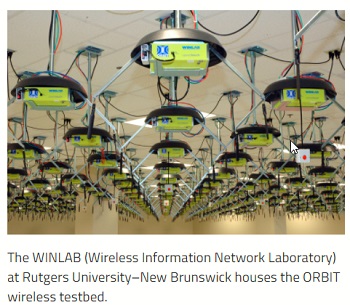
“COSMOS is an outdoor laboratory that will allow us to test entirely new classes of wireless applications such as smart intersections that can process massive data in real-time,” said principal investigator Dipankar “Ray” Raychaudhuri, a Distinguished Professor in the Department of Electrical and Computer Engineering in the School of Engineering at Rutgers–New Brunswick. He is also director of WINLAB (Wireless Information Network Laboratory).
By 2020, the number of internet-connected devices is expected to grow to 20 billion, creating an urgent need in the United States and abroad for infrastructure that can rapidly process all that data. To improve networking speeds, the New York City COSMOS network will tap previously unused radio spectrum bands and integrate optical fibers underground with radio antennas and other equipment on city rooftops and light poles.
The high-bandwidth, low-latency network is expected to allow applications to transmit data faster than 1 gigabit per second and reduce response times to a few milliseconds, improving performance tenfold over current wireless networks. To achieve this high level of performance, data processing will be handled by on-site “edge-cloud” servers rather than in distant data centers.
The open-access COSMOS platform will allow researchers from anywhere in the country to log in and try out their ideas for improving network performance and creating city-focused applications, from augmented-reality navigation for the blind to “smart” traffic lights.
The technologies underpinning the experiments will include:
mmWave Radio Bands: The use of new millimeter-wave bands, from 20 GHz to 200 GHz, will make it possible to extract more capacity from the radio spectrum, but one drawback is that mmWave signals don’t travel as far. To overcome this, researchers will use the network to test new radio and antenna designs and techniques for aiming radio waves directly to mobile devices.
Software-Defined Radios: Processing signals with software instead of hardware increases network flexibility and allows researchers to experiment with a wide range of frequency bands. The radios will be used to test new algorithms to support mmWave and flexible use of frequencies across various bands, a feature known as dynamic spectrum access.
Edge Cloud: By shifting data processing from cloud-based data centers to servers integrated into the wireless access network, researchers can speed up processing time. This is especially critical for applications involving internet-connected devices that require fast response time.
Advanced Optical Networking: To use edge-cloud infrastructure effectively, a fast front-haul network with high bandwidth and low-delay connectivity is needed to tie together computing clusters and the wireless access network. COSMOS will offer this connectivity with state-of-the art wavelength division multiplexed optical technology.
New York’s tech sector is now the nation’s third largest, after Texas and California, with most of those jobs concentrated in New York City. The city has embraced the COSMOS project for its potential to create far-ranging public benefits. These include bringing start-ups to the neighborhood that can build “smart city” applications that make cities safer and more resilient. Applications to come out of COSMOS could reduce the number of crashes that injure and kill drivers and pedestrians, improve accessibility for people with disabilities and make next-generation 911 systems more secure.
The project will also provide hands-on STEM training for students and West Harlem residents who will be among the first to see and touch technologies that are still years away from appearing on the market. Silicon Harlem will involve K-12 students from the community in the experiments, and City College will partner with researchers to involve engineering students on campus and support the testbed installation.
One key piece of radio equipment to be piloted will be the millimeter-wave wireless antennas and radio front-ends that will be unique to COSMOS. These mmWave radios will operate at 28 GHz, a frequency recently made available by the U.S. Federal Communications Commission.
The COSMOS research team is led by Raychaudhuri and Ivan Seskar (WINLAB associate director) at Rutgers; Gil Zussman, an electrical engineering professor at Columbia; and Sundeep Rangan, an electrical and computer engineering professor at NYU.
The Rutgers team and WINLAB will build on extensive research experience with wireless testbeds, software-defined radio technology and mobile internet architecture. WINLAB’s open-access, NSF-funded ORBIT wireless testbed is used by researchers nationally to run controlled experiments at scale. Other Rutgers COSMOS team members include electrical and computer engineering professors Marco Gruteser and Narayan Mandayam, who chairs the Department of Electrical and Computer Engineering and is associate director of WINLAB, and professor Thu Nguyen, who chairs the Department of Computer Science.
US Ignite, a nonprofit based in Washington, D.C., and Northeastern University oversee the NSF’s PAWR initiative.


